01 · Process
Biogas capture & treatment
Covered lagoon or CSTR, condensate management, biological plus iron-oxide desulfurisation, chilling, drying, blower and flare — sized to the engine specification.
KSTS designs, builds and supports biogas power plants and biomethane upgrading systems for palm oil mills across Sabah and Sarawak — with technology from SINOPEC Dalian Research Institute of Petroleum and Petrochemicals, and engineers from a Tsinghua University PhD team.
What we deliver
Most mills already have the raw material and the pond. What is missing is gas quality control, the engine package and one party accountable for the whole chain.
01 · Process
Covered lagoon or CSTR, condensate management, biological plus iron-oxide desulfurisation, chilling, drying, blower and flare — sized to the engine specification.
02 · Equipment
Containerised or skid-mounted biogas gensets, 415 V / 50 Hz, island or parallel operation, with jacket-water and exhaust heat recovery. Brushless doubly-fed generator available as an option for gas that swings.
Brushless doubly-fed option →03 · Delivery
Straight equipment supply, full EPC with local civil and mechanical works, or build-own-operate where we fund the plant and sell power or gas to the mill.
Two ways to monetise the gas
Route A · Power & heat
Inland Sabah mills often run diesel gensets at RM 0.55–0.75/kWh. POME biogas at 60% CH₄ can carry a large share of that load, with useful heat as a by-product.
Biogas to power →Route B · Biomethane
Where the mill needs boiler fuel more than electricity, biogas can be upgraded to ≥97% CH₄ for the existing burner, or compressed as bio-CNG and moved by trailer.
Biomethane & bio-CNG →Typical design basis
These are the ranges we use for pre-feasibility. Every project is re-based on one to two weeks of measured gas flow and composition.
| Parameter | Typical range | Why it matters |
|---|---|---|
| POME generation | 0.6 – 0.7 m³ / t FFB | Sets the pond and digester volume |
| POME COD | 50 – 80 g/L | Methane potential per m³ |
| Biogas yield (covered lagoon) | 20 – 28 Nm³ / m³ POME | The most uncertain number — we verify it |
| Methane content | 55 – 65% CH₄ | Drives gas flow per kWh |
| Hydrogen sulphide | 1,000 – 4,000 ppm H₂S | Decides desulfurisation duty |
| Operating hours | 7,000 – 8,000 h/year | Revenue and maintenance reserve |
KSTS project experience and published Malaysian POME data. Pre-feasibility only — not a performance guarantee.
Engineering tools
Seven calculators built on the formulas we use in proposals. No sign-up, no email capture.
Local presence
A biogas plant needs a DOSH-registered engineer for steam and I.C.E. inspection under FMA 1967, an ECOS-registered energy manager, and a CIDB contractor. KSTS holds all three.
Managing Director
B.Eng.Tech(Mech Eng)(USQ)• Eng Tech (BEM)• ASEAN Eng Tech (AER)• IncIEM• MMOSTA• Grad Tech (MBOT)• TMIEAust
Permitting and statutory inspection are usually the schedule risk, not the engine. Having DOSH and ECOS registrations in-house means the plant is designed to the inspection regime from day one.
| Civil & mechanical | CIDB-registered execution, local labour and plant |
| Statutory | FMA 1967 steam and I.C.E. inspection |
| Energy case | ECOS-registered energy manager reporting |
| O&M | Local crew, remote support from the factory |
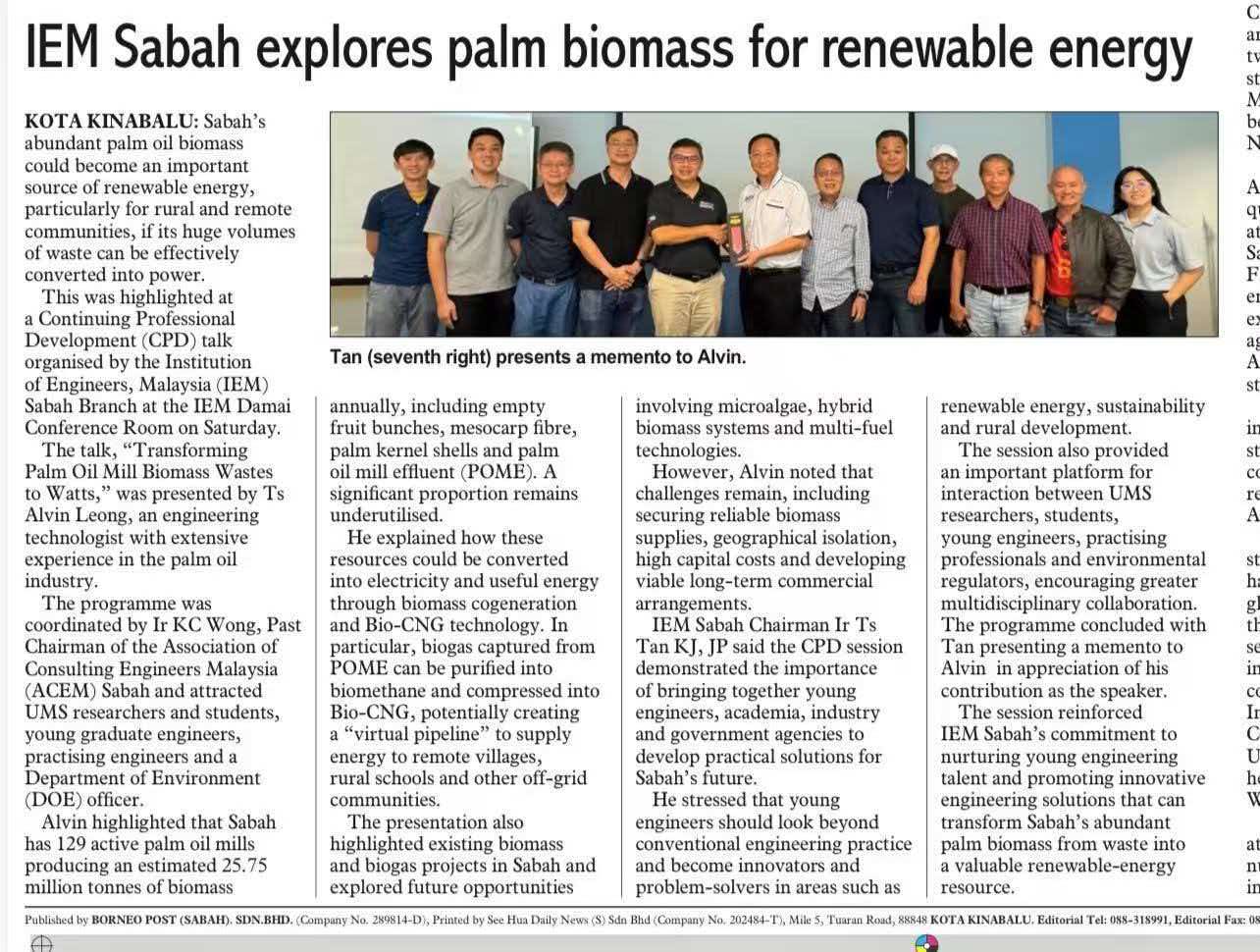
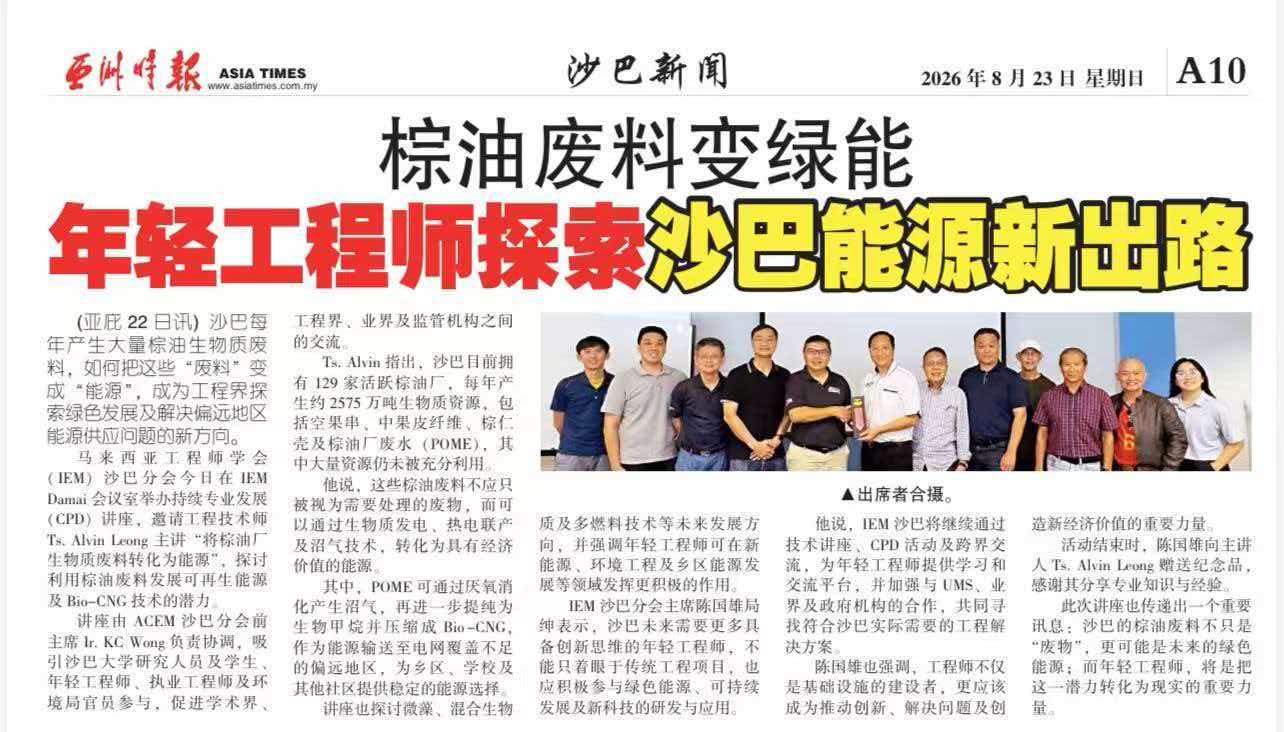
In the news
Alvin Leong presented “Transforming Palm Oil Mill Biomass Wastes” at the IEM Sabah Branch CPD talk in Kota Kinabalu — cogeneration and Bio-CNG from palm kernel shells, palm fibre and POME.
Sabah has 129 active palm oil mills producing an estimated 25.75 million tonnes of biomass a year.
Read moreSend throughput, pond volume and one week of gas data if you have it. We come back with a capacity, a gas specification and a budget.