01 · Proven architecture
Engine, not absorption
Mechanical compression gives about 1.5× the cooling of a single-effect absorption chiller on the same gas input, with no lithium bromide, no corrosion loop and no crystallization risk.
Biogas Heat Pump (BHP) · 30–480 kW
A mill’s air-conditioning usually hangs off one spine: boiler, steam turbine, mill grid, electric chillers. Stop the boiler and the offices, laboratory and worker housing cook — just when the mill needs them most. The BHP system breaks that dependency. A small gas engine drives the compressor directly, and the fuel is 97% biomethane made from the mill’s own biogas. There is no electric motor in the drive train, no grid connection and no diesel.
The single point of failure
This is the chain that decides whether a mill has air-conditioning on any given day. Every link is electrically or thermally dependent on the one before it.
The BHP chain
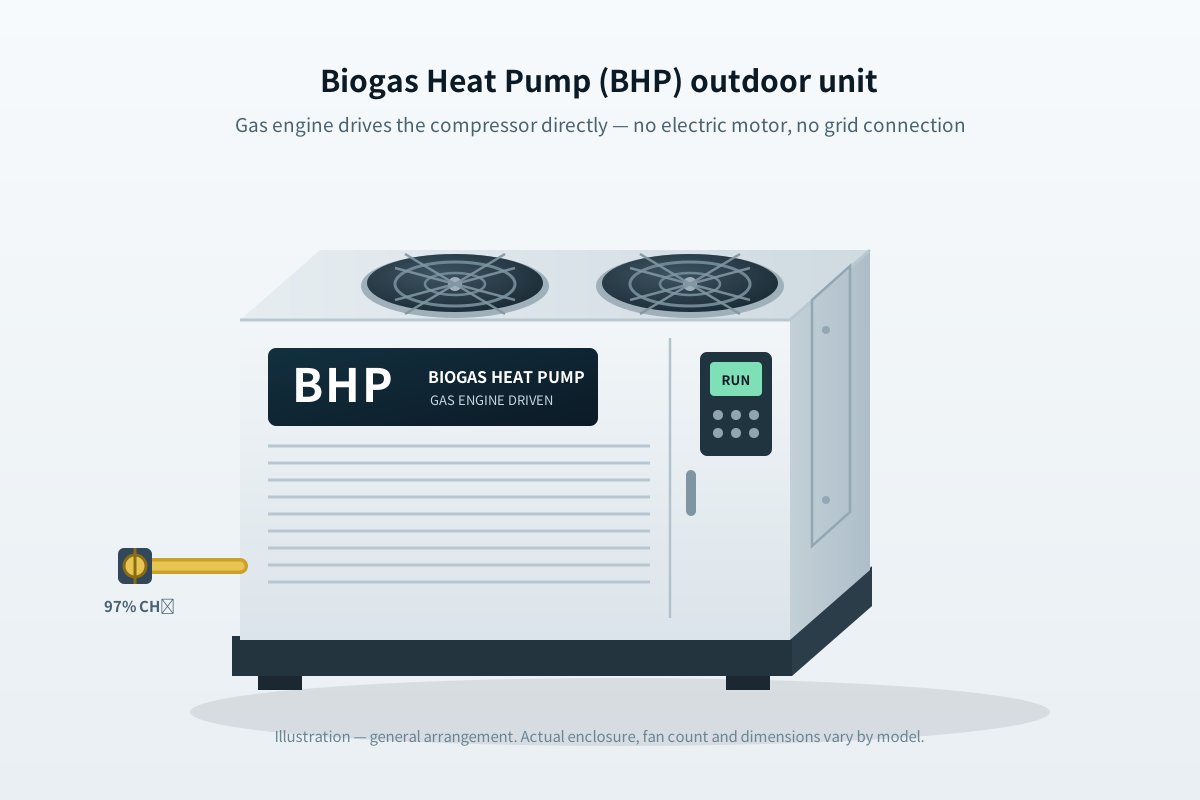
The unit
The engine, compressor, condenser, gas train, starter battery and controller arrive on one skid, factory run-tested. Set it on a plinth, connect the gas line, the chilled-water or refrigerant lines and a small control cable. No motor control centre, no soft starter, no transformer upgrade.
How it works
The engine does mechanical work on the compressor — it is not an absorption chiller. That is why one Nm³ of methane gives roughly 10 kWh of cooling, about 1.5 times what a single-effect absorption chiller extracts from the same gas.
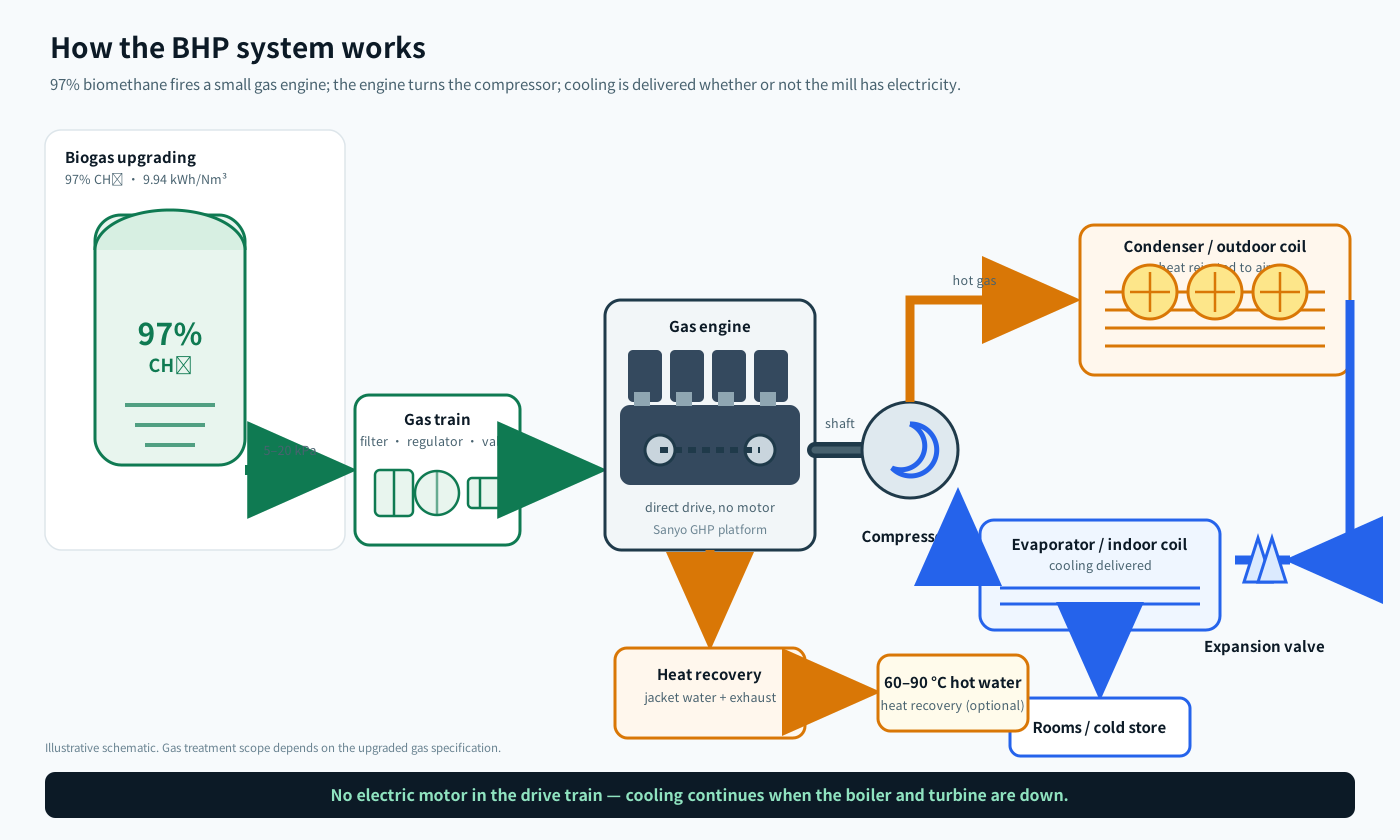
The COP quoted here is on fuel LHV, the way gas heat pumps are rated in Japan. On an electrical-equivalent basis the compressor itself runs at a COP of about 3.0 — the same as a good electric chiller; what changes is where the shaft power comes from.
Technology origin
Gas-engine heat pumps were developed and industrialised by Sanyo’s air-conditioning division in Japan. The same class of machine is built in China by Dalian Sino-Tech Precision (Sino-Tech). BHP takes that proven mechanical architecture — gas engine, open-drive compressor, engine heat recovery — and adapts the fuel system to 97% biomethane from palm oil mill waste.
01 · Proven architecture
Mechanical compression gives about 1.5× the cooling of a single-effect absorption chiller on the same gas input, with no lithium bromide, no corrosion loop and no crystallization risk.
02 · What we change
Gas train sized for 97% methane, air/fuel ratio and ignition timing remapped, knock control and derating for methane-number variation, biogas-compatible oil and service intervals.
03 · What stays
Industrial reciprocating engine, open-drive compressor, copper-tube aluminium-fin coils, service access from the front. Overhaul at 20,000–30,000 h; 15-year design life.
Reference machines of this class include Panasonic GHP outdoor units and Dalian Sino-Tech Precision (Sino-Tech) gas-engine heat pump packages. BHP is our biogas-adapted package; performance figures on this page are indicative and are confirmed against the manufacturer’s guarantee sheet for each project.
Range
Fuel input is at rated cooling, COP 1.0 on methane LHV. Hot water is recoverable engine heat at a 50 K rise (20 → 70 °C), cooling mode. Parallel units for larger loads.
| Model | Cooling (kW) | Fuel input (kW) | 97% CH₄ (Nm³/h) | Recoverable heat (kW) | Hot water 50 K (L/h) |
|---|---|---|---|---|---|
| BHP-30 | 30 | 30.0 | 3.0 | 7.5 | 129 |
| BHP-60 | 60 | 60.0 | 6.0 | 15.0 | 258 |
| BHP-120 | 120 | 120.0 | 12.1 | 30.0 | 517 |
| BHP-240 | 240 | 240.0 | 24.1 | 60.0 | 1,033 |
| BHP-480 | 480 | 480.0 | 48.3 | 120.0 | 2,067 |
Basis: methane LHV 9.94 kWh/Nm³; cooling COP 1.0 on fuel LHV (typical for this class, 0.95–1.15 depending on ambient and part load); 25% of fuel input recoverable as hot water in cooling mode. Confirm against the model guarantee sheet before purchase.
Economics
Per 100 kW of cooling, 8,000 hours a year. The BHP column assumes the mill upgrades its own biogas at RM 0.60/Nm³; if raw biogas can be used directly the fuel cost falls, but engine derating and shorter service intervals must be priced in.
| Option | Cooling per year (kWh) | Fuel per year | Fuel cost (RM/y) | Maintenance (RM/y) | RM per kWh cooling | Works without grid? |
|---|---|---|---|---|---|---|
| BHP | 800,000 | 80,500 Nm³ CH₄ | 48,300 | 7,500 | 0.070 | Yes |
| Diesel genset + electric A/C | 800,000 | 83,300 L diesel | 179,100 | 12,000 | 0.239 | Yes, while fuel lasts |
| Grid + electric A/C | 800,000 | 266,700 kWh | 120,000 | 8,000 | 0.160 | No |
Assumptions: electric A/C COP 3.0; diesel genset 3.2 kWh per litre at RM 2.15/L; grid tariff RM 0.45/kWh; BHP cooling COP 1.0 and upgraded biogas RM 0.60/Nm³. Indicative only — every site differs.
Worked example · 120 kW
A 120 kW BHP unit carries the office and laboratory load. Against diesel-generated electricity it saves about RM 162,000 a year. At an indicative RM 2,500/kW for the equipment, payback is about 1.8 years — before any grant or carbon credit.
When it is not the answer
If the mill has firm grid power at RM 0.35–0.45/kWh and the boiler never stops, an electric VRF system is cheaper to buy and cheaper to run. BHP earns its place where the grid is absent or unreliable, where the turbine stops, or where diesel is the cooling fuel today. Be honest about which case you are in.
Scope & terms
| Included | Engine, compressor, condenser, evaporator/indoor units, gas train, starter battery, controller, heat-recovery exchanger, factory run test |
| Optional | Hot-water heat recovery, remote monitoring, acoustic canopy, spare-parts kit, O&M contract |
| Excluded | Biogas upgrading plant, civils and foundations, gas piping to the unit, chilled-water piping, electrical distribution, permits, freight and SST |
| Fuel specification | CH₄ ≥ 95%, H₂S < 10 ppm, siloxanes < 5 mg/Nm³, dew point ≤ 5 °C, 5–20 kPa at the unit inlet |
| Service interval | Oil and plugs every 2,000 h; top overhaul 10,000 h; major overhaul 20,000–30,000 h |
| Lead time | 4–6 months from order and gas analysis |
What we need to size it
We return a unit selection, a gas specification and an indicative budget within three working days.
All figures on this page are indicative engineering estimates for pre-feasibility. Formal quotation requires gas analysis, cooling load and site survey.